Stop chasing work-life balance
Design and grow your petri dish

Prefer to listen? Here’s the audio version of this article.
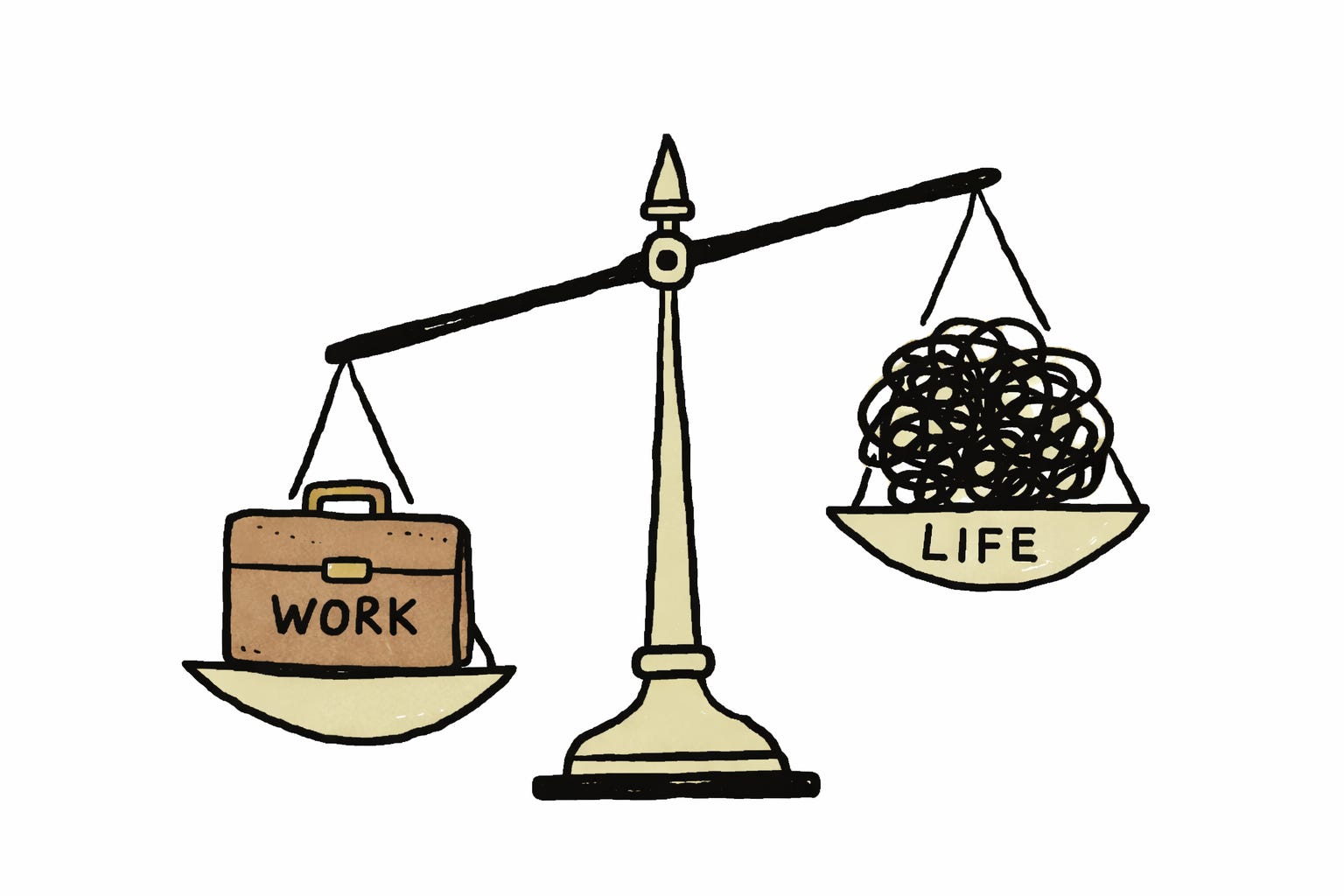
People think about “work-life balance” like it’s a scale. Work on one side and life on the other. If it tips to the left, the answer is ostensibly to change something to rebalance. It’s this imbalance, some might argue, that leads to frustration and stress.
This whole logic stands on three prevailing assumptions:
Balance is the path to happiness or less suffering. The idea is: If you can get work and life into balance, you’ll feel better.
A correct balance exists. There’s some right ratio of work to life.
Work and life are clean, equivalent sides you can toggle. Underneath that, we assume “life” and “work” are equivalent units you can adjust like sliders on a board.
What are the pitfalls of the conclusion and these assumptions?
The history of what “balance” was trying to fix
The early research in the 70s-80s didn’t talk about “balance” or the friction between work and life. It talked about conflict between work and family. Specifically, Greenhaus and Beutell’s 1985 paper details three types of work-family challenges:
Time-based conflict: When the demands of one role make it difficult to meet the expectations of another, e.g., clashing schedules.
Strain-based conflict: When stress in one domain spills over into the other, e.g., anxiety, fatigue, or irritability in one role affects how we show up in the other.
Behavior-based conflict: When behaviors that fit one role (e.g., being blunt and competitive at work) clash with what’s expected in another (e.g., being playful and emotionally available at home).
The key point is that there’s the presence of two roles with incompatible pressures that create conflict. The original concept never assumes that conflict flows from one direction to the other. In reality, it’s bi-directional. Not only does it not place blame on a single domain, it doesn’t suggest that “balancing” one side against the other is the solution.
Conflict arises from the choices we make, regardless of the domain. If we say yes to late meetings and miss family dinners, it’s easy to blame work for lacking family time. On the other hand, if we decline projects to cover home responsibilities, we may start blaming family for missed career opportunities. An imbalance isn’t the issue in both cases. The narrative of blame often obscures the truth: We made a choice, and each choice comes with a tradeoff.
Why is work-life balance a myth
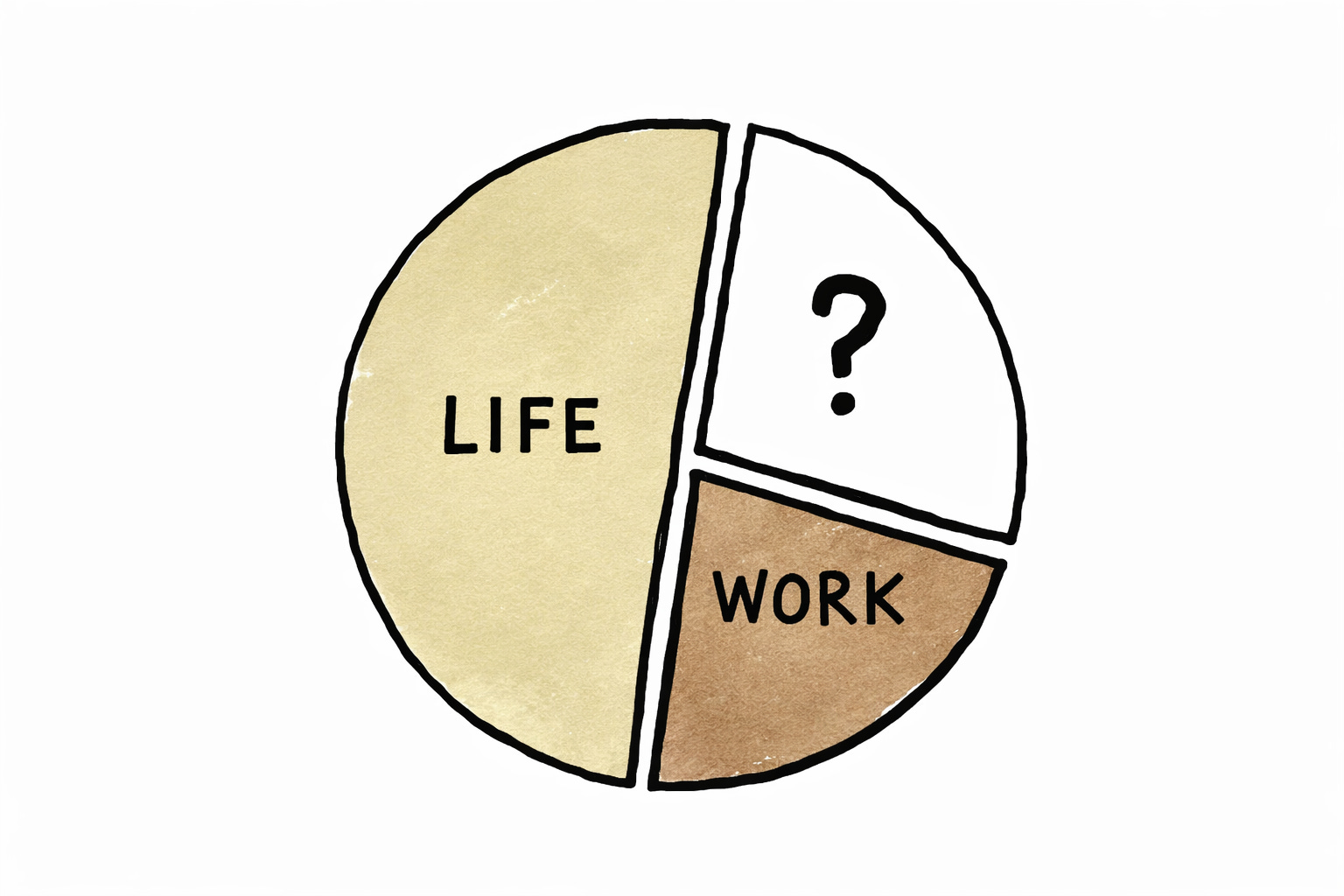
The first assumption is that if we achieve work-life balance, we’ll feel better. Balance becomes a means to an end: More time for pleasure, joy, and happiness, or less anxiety and stress.
But do we really believe that the culprit standing in the way is an imbalance between work and life? People can be miserable in jobs with reasonable hours and good pay, while others feel fulfilled doing intense, underpaid work.
This assumption offers the first crack in the work-life balance myth. We behave as if imbalance is the main reason we feel uncomfortable, unsatisfied, or unwell, when the real issues may be more direct than some imbalance. Our happiness or suffering may be influenced by the type of work we do, the control we have or lack, our compensation, stability, health, or home dynamics.
The second assumption is that we must find the correct balance. Once we discover the right ratio and recalibrate the weights, we’ll finally achieve what we’ve been striving for.
But is there really such a thing as a “correct” balance? Is it universal or is it different for a 24-year-old single person, a couple, a family, and a single parent? Does it remain constant or shift with time? And if it’s not universal, how can a business create policies that satisfy everyone’s version of balance?
The language itself (“balance”) implies a precise ratio of work to life and reduces complex challenges to something measurable, as if toggling one side of the equation could solve the whole problem. What we’re changing here is unclear. What the “right mix” is may not exist. “Work-life balance” suggests that the solution is simple when “work” and “life” alone are not. An imbalance alone doesn’t fully and precisely explain the discomfort we genuinely feel.
The third assumption is that work and life are equivalent sides of the same scale. Equal units.
We know from experience that both work and life move in seasons. There are ups and downs, stability and chaos, clarity and uncertainty, wellness and illness. Work has cycles. Life has even larger ones. Expecting a constant 50/50 split is unrealistic and doesn’t make sense when seasons change.
Sometimes we make tradeoffs at work that have nothing to do with life outside of it, and vice versa. They may interact, but they’re also independent. A scale, then, is an incomplete mental model for understanding the work-life relationship. And if we take this balanced-scale seriously, it becomes impractical for ourselves and others to come up with a targeted solution.
Cultivate your petri dish

Greenhaus and Beutell frame the issue as a conflict, not as “…a state where work and personal life peacefully coexist, and I feel satisfied in both.” For them, balance isn’t the solution. Instead, it’s about reducing the incompatibility of roles/pressures. This reframing helps clarify the issue that it’s not just about how many hours we spend in one domain versus another, but instead it’s about the pressure of competing roles.
We’ve all had moments of long work hours without feeling imbalanced because of low family pressures, and vice versa. The conflict we experience and the imbalance we feel often comes from the guilt of not fulfilling the demands of multiple roles. Furthermore, this isn’t merely work versus life. Tensions can emerge from work versus family, family versus community, community versus personal needs, and many other combinations.
Because of this, we should consider retiring the old work-life balance model and adopt a new one that better reflects what we actually mean when we say we want balance: The petri dish.
Life is the dish, and inside it, work is one culture growing alongside others: personal, familial, and community. Like cultures in a petri dish, they can feed one another, crowd one another, and mutate over time. In this analogy, we don’t “balance” cultures, we shape the conditions (e.g., time, energy, expectations, tools, support) that allow the best mix to grow for whatever season of life we’re in. Seeing conflict through this lens offers clearer direction. It encourages solutions that address the pressures of multiple roles directly, rather than relying on a static, one-sided fix.
What can individuals do?

First, identify whether the problem is a time, strain, or behavior conflict. Secondly, is it a work vs. family conflict, a family vs. family conflict, a work vs. work conflict, or some other combination outside of work and family. Knowing the conflict type and the domain it’s in can guide us towards specific and relevant solutions.
For instance, if it’s a time-based conflict between work and family pressures, maybe we have to adjust expectations around availability, clearer guidelines around meeting hours, or shifting tasks earlier in the day.
Or if it’s a behavior-based conflict between two family roles like caring for an aging parent and raising a young child, these pressures may create challenging circumstances. Here, the solution might involve asking for shared caregiving and adjusting family routines.
What can leaders do?
We’ll focus on the work domain here, because that’s where leaders will have more levers.
First, stop promising “balance.” It’s hard to operationalize. Instead, talk about fit and seasons in plain terms, and tie it back to concrete actions. For example: “We’re coming to a heavy stretch. Next month, we’ll adjust scope, identify how long it’ll last, and identify what support looks like.” Unlike “im/balance”, this is something you can design around.
Second, make boundaries and seasons a normal topic of discussion, and treat policies as experiments. Instead of one big “work-life” policy for optics, practice ongoing adjustments based on effort, needs, and projects (Khateeb, 2021).
For example, have consistent discussions (doesn’t have to be long) to gauge how people like to separate or blend work and non-work. Revisit and revise basic operational workflows like deep-work time, messaging hours, and expectations. Pilot different meeting cadences and team structure, and see what’s most helpful.
The point here isn’t to customize schedules for everyone. It’s a signal that you care about how people’s job lands in their life, and that you’re willing to adjust where it’s reasonable (Ammons, 2013).
Third, drop “balance” as the goal. It’s not as neat as it’s sold. Your aim is to run an organization where work is one strong culture of many in the petri dish. It’s not something people have to escape from. You want an organization where people have enough control and support to shape their work environment so they can do their best work with you, not around you. And you want an organization with policies that are tools to guide conditions, not boxes to check off or proof that you care.
Being able to do these things is much harder than framing “we support work-life balance” on a wall. But as hard as it is, it’s the most sincere thing to do as a leader because it fits closer to how work and life actually behave, and it’s a more precise approach to the uncomfortable feeling we’ve felt with competing roles and pressures.
Resources
Ammons S. K. (2013). Work-family boundary strategies: Stability and alignment between preferred and enacted boundaries. Journal of Vocational Behavior, 82(1), 49-58. https://doi.org/10.1016/j.jvb.2012.11.002
Greenhaus, Jeffrey & Beutell, Nicholas. (1985). Source of conflict between work and family roles. The Academy of Management Review, 10, 76-88. 10.2307/258214.
Khateeb, F.R. (2021). Work life balance: A review of theories, definitions and policies. Cross-Cultural Management Journal, 23(1/2021). seaopenresearch.eu/Journals/articles/CMJ2021_I1_3.pdf